Tesla Wall Connector Installation Ballarat
If you've purchased a Tesla Wall Connector for your Ballarat home, installation can be arranged through Ballarat EV Home Charging. This page explains what the unit needs from your home's electrical supply, where it can be mounted, and what happens at setup — so the outcome is a tidy, working home charger.
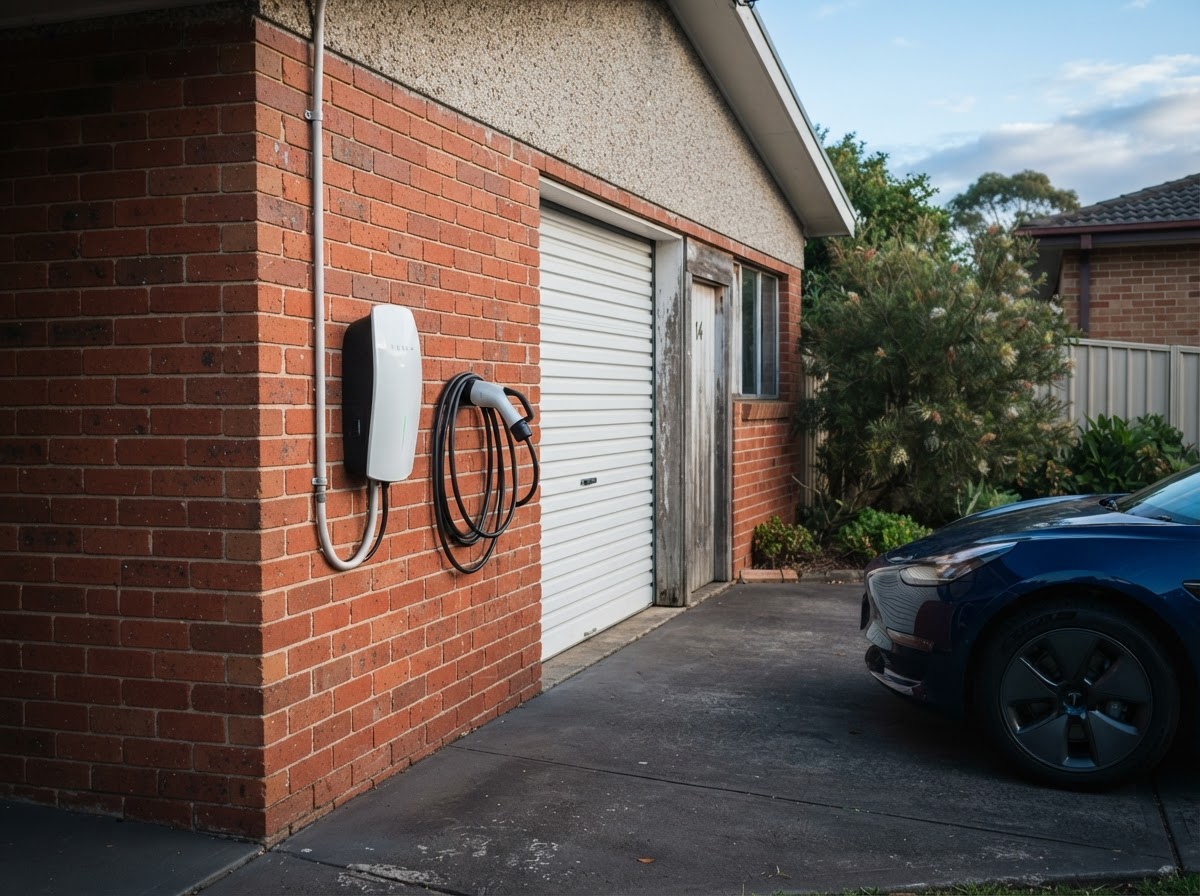
Ballarat EV Home Charging is an independent local service and is not presented as Tesla or as an official Tesla representative. Tesla and Tesla Wall Connector are used here only to describe the equipment being installed.
Electrical supply
What the Wall Connector needs from your home
A Wall Connector is a hardwired unit installed on its own dedicated circuit. On a single-phase supply — common across Ballarat — it's typically configured to a single-phase output, commonly around 7kW where the switchboard and available capacity allow. On a three-phase supply it can be configured for a higher output, though the practical result still depends on your vehicle.
The unit is configured at commissioning to suit the circuit installed, so the supply assessment comes first and the configuration follows. Available capacity, switchboard space and existing household load all feed into that.
Placement
Wall placement, cable routing and outdoor installation
Mounting height and position should suit both the vehicle's charge port and the length of the tethered lead, so the cable reaches comfortably without stretching across a walkway. In a single garage this is usually straightforward; with tandem parking, a carport or a driveway, it's worth thinking about where the car really stops.
The unit is rated for outdoor installation, but placement should still consider weather exposure, direct afternoon sun, the mounting surface and cable management. Ballarat gets genuinely cold, wet weather, so a sheltered position is generally preferable where one is available.
Wi-Fi connectivity, setup and commissioning
Wall Connectors connect to home Wi-Fi for configuration, monitoring and firmware updates, so reasonable signal at the mounting position matters — detached garages and sheds sometimes need a Wi-Fi extender. Commissioning covers configuring the unit for the installed circuit, testing, connecting it to your network and confirming a charge session before handover.
Good to know
Charging speed, compatibility and solar
Charging speed limits. The Wall Connector will not exceed what your vehicle's onboard AC charger accepts, or what the installed circuit allows. That means the real-world charging rate is set by the slowest of the three: car, circuit and charger configuration.
Non-Tesla vehicles. Later Wall Connector versions can charge many compatible non-Tesla EVs using a Type 2 connection. Compatibility should be confirmed for your specific vehicle and the exact version of the unit before you rely on it.
Gen 3 considerations. Gen 3 units are tethered, Wi-Fi connected and configured during commissioning, and are commonly the version homeowners buy today. Older generations can differ in mounting, connector type and configuration, so tell us which version you have.
Solar charging. Charging during the day makes better use of rooftop solar, and scheduling can help. How closely charging can follow your solar output depends on your solar system, metering and the charger's capabilities, so it needs to be assessed rather than assumed.
Quoting
What we need to quote a Wall Connector installation
- Wall Connector version, if known
- Vehicle make, model and year
- Your Ballarat suburb
- Photos of the main switchboard and meter
- Photo of the proposed mounting wall
- Where the car parks
- Approximate switchboard-to-charger distance
- Single-phase or three-phase, if known
- Whether the position is indoors or outdoors
Talk about your Wall Connector installation
Send a few details about your vehicle, parking area and switchboard and we'll help you understand the next step.