Can My Ballarat Home Support an EV Charger?
Most Ballarat homes can support a home EV charger in some form — the useful question is what form, and what needs checking first. This page walks local homeowners through supply type, switchboard capacity, cable routes and the practical differences between older homes and newer estates, so you know where you stand before requesting a quote.
Your supply
Single-phase or three-phase?
Most Ballarat houses are single-phase, which commonly supports a charger of around 7kW where capacity allows. Three-phase supply is less common in established residential streets but does appear in some newer builds and renovated properties, and it's what a 22kW charger requires.
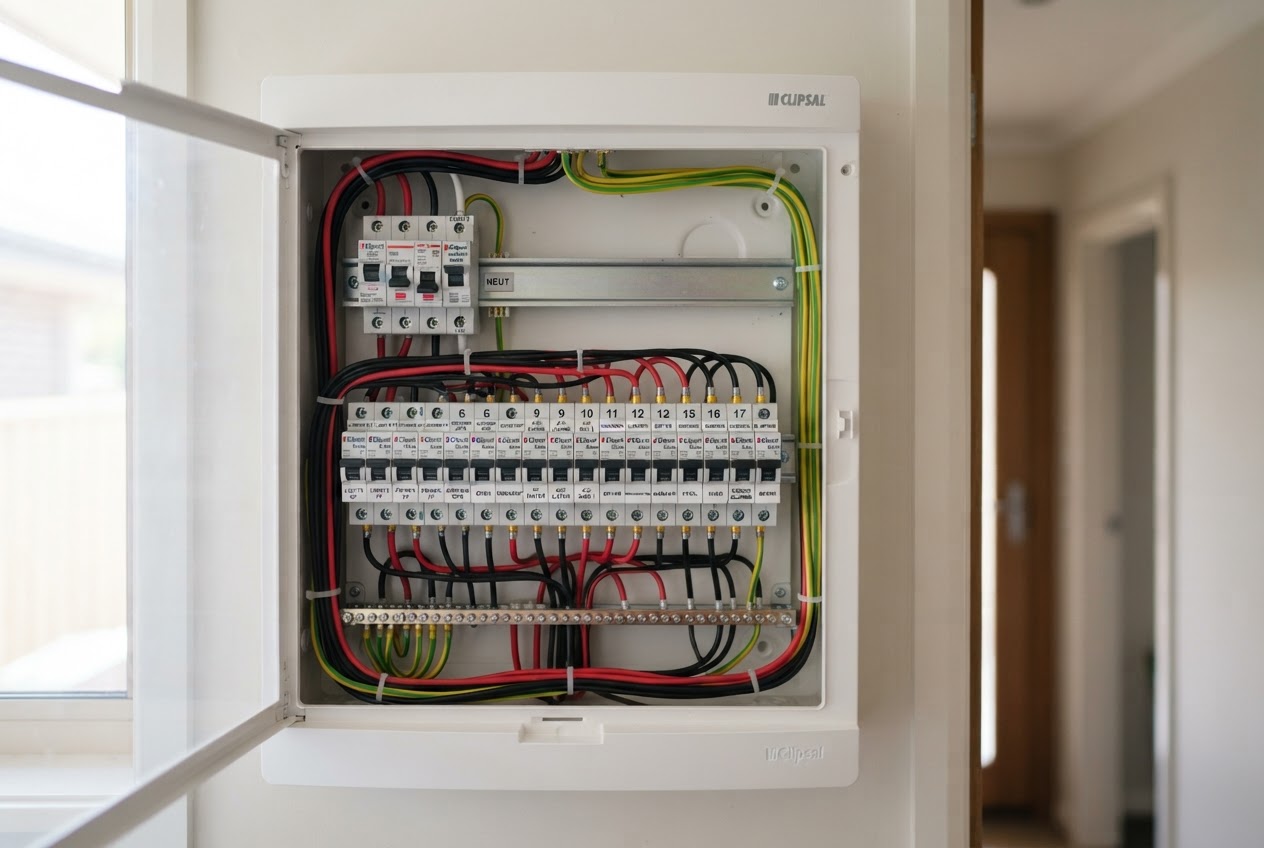
If you're not sure which you have, a photo of your main switchboard and meter area usually answers it. Don't open panels or remove covers — an external photo of the board with the door open, if it opens safely, is enough.
Switchboard condition and available capacity
A new charger needs its own circuit, which means space on the board and appropriate protection. Some older boards are already full, use older protection devices, or would need updating before a charger circuit is added. Capacity also matters: your main switch rating and existing household load determine how much is left for charging.
Layout
Cable route and charger location
The distance and path between switchboard and charger is often the biggest practical factor. A garage wall backing onto the switchboard is simple. A detached shed at the rear of a long block may involve trenching. A charger on the far side of the house may need a run through a roof space or under the floor.
Where you park matters as much as where the wall is. The charger should sit close enough for the lead to reach the car's charge port comfortably, without crossing a path or doorway.
Property types
Older Ballarat homes and newer estates
Established homes
Older detached homes in areas like Soldiers Hill, Black Hill, Golden Point or Redan often have the switchboard at the front or side, sometimes with an original board and limited spare space. Charging usually still works well — it just warrants a closer look at the board and the route to the garage or carport first.
Newer estates
Homes in Lucas, Alfredton, Winter Valley and Delacombe generally have modern boards and tidy garage layouts, which helps. The considerations shift to available capacity alongside other electrical loads, cable routing through a slab-on-ground build, and where the car sits in a double garage.
Solar-equipped properties add another element: the inverter position, metering and whether you want the charger to work with your solar. Load management can also help homes where capacity is tight, by reducing the charger's draw when the rest of the household is busy rather than requiring an upgrade.
Where upgrades are needed — switchboard work, protection changes or supply changes — that will be identified in the assessment and explained before anything proceeds. Any fixed electrical work is completed by appropriately licensed and registered electrical contractors.
Checklist
Home EV Charger Readiness Checklist
- Vehicle make, model and year
- Whether you already own a charger
- Photo of your main switchboard
- Photo of the electricity meter area
- Proposed charger location and wall type
- Approximate switchboard-to-charger distance
- Single-phase or three-phase supply, if known
- Rooftop solar and inverter details
- Wi-Fi coverage at the charger position
- Indoor or outdoor mounting
- Landlord or owners corporation approval, if applicable
- Whether a second EV is likely later
- Preferred charging times
Send your switchboard photos for an assessment
Send a few details about your vehicle, parking area and switchboard and we'll help you understand the next step.